

The Format That Never Dies
Someone sits down, looks at the camera, and says "Okay so this is insane but..."
And you're locked in for the next 90 seconds.
Storytime videos have been one of the most consistent content formats on TikTok and YouTube Shorts for years now. And in 2026, they're bigger than ever.
Why? Because stories are literally hardwired into our brains. A good storytime video gets 70-85% watch-through rates. The platform average sits around 50%.
That's not a small edge. That's the algorithm handing you free distribution.

Whether you want to film yourself telling stories or go completely faceless with AI narration, this guide covers the entire process.
Let's get into it.
How to Make Storytime Videos (Step by Step)
Step 1: Find or Write Your Story
This is the foundation. A bad story with perfect editing still flops. A great story with mid editing still goes viral.
Here's where to find stories that work:
- Reddit - Subreddits like r/AITA, r/tifu, r/pettyrevenge, and r/relationship_advice are goldmines. These stories are pre-validated by thousands of upvotes.
- Personal experiences - Your own life is content. That insane thing that happened at work? The worst date you've ever been on? Use it.
- Viewer submissions - Once you build an audience, ask them to DM you their stories. This is an infinite content engine.
- News and current events - Wild headlines make great storytime jumping-off points.
- "What would you do?" scenarios - Hypothetical moral dilemmas get insane engagement because everyone has an opinion.
The best storytime content has conflict, stakes, and a payoff. If a story doesn't have those three things, keep scrolling.
Step 2: Script It for Short-Form
You found a great story. Now you need to make it work in 60-90 seconds.
This means cutting ruthlessly.
The rule: if a sentence doesn't move the story forward or add tension, delete it. Nobody cares about setup details like "So my friend Sarah, who I've known since third grade, we met at summer camp actually..." Just say "my friend."
Here's a simple script structure:
- Hook (first 2 seconds) - The most dramatic or surprising part of the story, teased upfront
- Context (5-10 seconds) - Bare minimum background so the story makes sense
- Rising action (30-40 seconds) - The conflict builds
- Climax (10-15 seconds) - The peak moment
- Resolution or cliffhanger (5-10 seconds) - Either deliver the payoff or tease Part 2
Keep sentences short. Write the way people actually talk.
Step 3: Record or Use AI Narration
You've got two paths here.
Face-on-camera: Film yourself telling the story. Use natural hand gestures, facial expressions, and pauses for dramatic effect. This builds a personal brand and makes people feel like they know you.
Faceless with AI narration: Use a text-to-speech tool to generate a voiceover. This is faster, more scalable, and works great for creators who don't want to be on camera.
GhostShorts' AI Story Video tool lets you paste a script and generate a complete narrated video with AI voiceover, visuals, and captions. No recording needed. No editing needed.
For Reddit-sourced stories specifically, the Reddit Story Video generator lets you paste a Reddit URL or story text and get a finished video in about 2 minutes.
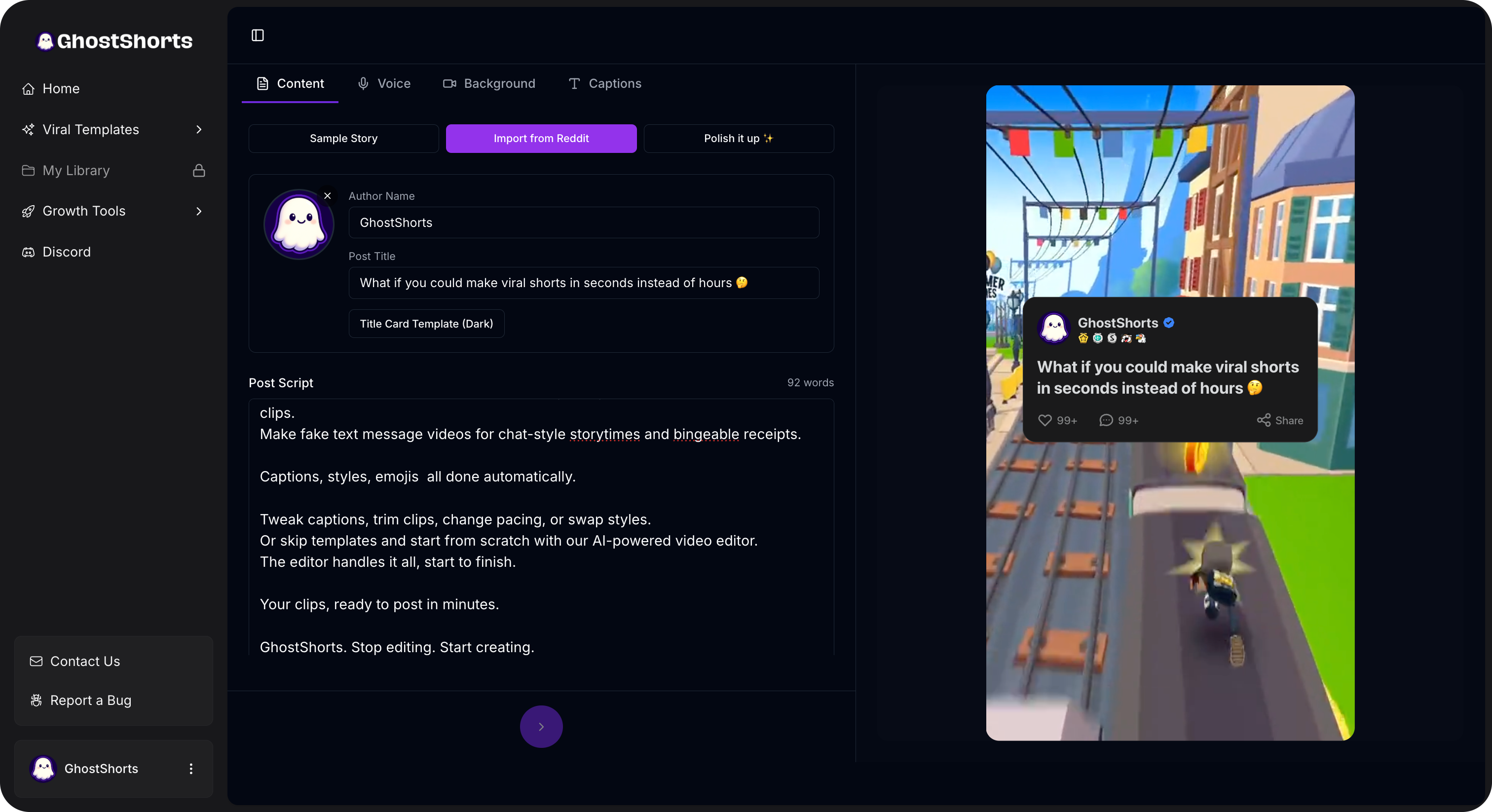
Instead of spending 30-45 minutes per video manually, you can batch-create an entire week of storytime content in one session.
Step 4: Add Visuals or Background Footage
If you're filming face-on-camera, this step is handled. But for faceless storytime videos, you need something visual on screen.
Popular background options:
- Gameplay footage - Minecraft parkour, Subway Surfers, GTA driving. The "satisfying gameplay + story" combo is tried and tested.
- AI-generated images - Tools like GhostShorts can create visuals that match your story beats. This looks way more polished than generic gameplay.
- Stock footage montages - Clips that loosely match the story's setting (city streets, office environment, etc.)
- Reddit post screenshots - Show the actual post on screen while the narration plays. Simple and effective.
The key is giving viewers' eyes something to do while their brain processes the story.
Step 5: Add Captions
This is non-negotiable.
85% of TikTok and YouTube Shorts viewers watch without sound at some point during their scroll session. No captions means you lose a huge chunk of your audience.
Animated, word-by-word captions also add visual energy to your video. They make the pacing feel faster and more engaging.
GhostShorts' AI Caption tool auto-generates accurate, animated captions for any video or audio clip. You can also use it to generate trending hashtags for your post.
Step 6: Edit for Pacing and Hook
Your first two seconds decide everything.
If someone scrolls past your hook, nothing else matters. Not your story, not your editing, not your captions.
Strong hooks for storytime videos:
- "I got fired for something I didn't do. Then I found out who set me up."
- "My neighbor threatened to sue me over a fence. So I did some digging."
- "This is the worst Airbnb experience anyone has ever had."
After the hook, keep the pacing tight. Cut dead air. Speed up any section that drags. Add sound effects at key moments (a record scratch, a dramatic sting, a notification sound).
Every 10-15 seconds, you should have a mini-hook that keeps people watching.

Want to skip the editing?
GhostShorts turns your ideas into viral shorts with AI voiceovers, captions, and gameplay clips. Ready to post in minutes.
Try GhostShorts TodayBest Storytime Niches (and What They Pull)
Not all stories perform equally. Some niches consistently outperform others.
| Niche | Avg. Views Per Video | Why It Works |
|---|---|---|
| Horror/creepy encounters | 500K - 5M+ | Fear is the strongest emotion for retention |
| Relationship drama | 300K - 3M+ | Everyone relates to love and betrayal |
| Revenge stories | 200K - 2M+ | Satisfying payoffs keep people watching |
| Workplace chaos | 150K - 1M+ | "Terrible boss" stories are universally relatable |
| Travel gone wrong | 100K - 800K+ | Adventure + danger = high engagement |
| Parenting fails | 100K - 500K+ | Parents share these like crazy |
| Neighbor disputes | 100K - 500K+ | Petty conflicts are weirdly addictive |
| "What would you do?" | 200K - 1M+ | Moral dilemmas drive comment sections |
Horror and relationship drama are the two highest-performing niches by a wide margin. If you're just starting out, pick one of those.
But here's the thing. The niche matters less than the story itself. A perfectly told parenting fail will outperform a boring horror story every time.
The Anatomy of a Viral Storytime Video
After analyzing thousands of storytime videos that crossed 1M views, there's a clear pattern.
The hook (0-2 seconds): Drop the viewer into the most dramatic moment. Don't start at the beginning. Start at the peak and then rewind.
"So I'm standing in the airport, my passport is gone, and the flight leaves in 40 minutes."
That's infinitely better than "So last summer I went on a trip to Spain..."
The tension loop (throughout): Every 10-15 seconds, introduce a new complication or piece of information that makes the viewer need to know what happens next. Think of it like a series of mini-cliffhangers within the same video.
The emotional payoff (end): The story needs to land somewhere satisfying. Justice served, lesson learned, plot twist revealed. If your ending is weak, people won't follow you for Part 2.
Or... you don't give them the payoff at all.

How to Turn One Story Into a Multi-Part Series
This is the growth hack that storytime creators swear by.
The Part 1 / Part 2 / Part 3 strategy is one of the most effective ways to gain followers on TikTok and YouTube Shorts. Here's why it works:
When someone watches Part 1 and the video ends on a cliffhanger, they have two options. Scroll your profile to find Part 2, or follow you so they don't miss it.
Either way, you win.
How to split a story into parts:
- Find a story that's long enough for 2-4 videos (aim for stories that take 3+ minutes to tell)
- Identify natural cliffhanger points, moments where the tension peaks but isn't resolved
- End each part RIGHT at the most suspenseful moment
- Start the next part with a 3-second recap ("If you didn't see Part 1, my landlord just told me...")
- Put "Part 1," "Part 2," etc. clearly in the video text and caption
The golden rule of multi-part storytime: each part needs to work as a standalone video too. If someone discovers Part 3 first, it should be interesting enough on its own that they go find Parts 1 and 2.
Some creators have built entire channels around this. One story becomes 3-5 videos, each driving traffic to the others. Multiply that across dozens of stories and you've got a content machine.
Pro tip: Pin Part 1 of your current series to your profile. When new viewers discover any of your videos, they'll see the pinned post and start from the beginning. This maximizes watch time across your entire series.
Faceless vs. Face-on-Camera Storytime
Both approaches work. The right choice depends on your goals.
Face-on-camera pros:
- Builds personal brand and parasocial connection
- Higher follower conversion rate (people follow people, not formats)
- Easier to get brand deals (sponsors want a face to associate with)
- Your reactions and expressions add entertainment value
Face-on-camera cons:
- Slower to produce (filming, lighting, multiple takes)
- Can't batch as easily
- You're the bottleneck; if you're sick or traveling, content stops
Faceless storytime pros:
- Massively scalable (10+ videos per session is realistic)
- No need for camera, lighting, or a good filming space
- Can outsource or automate with AI tools
- Works great for sensitive or anonymous stories
Faceless storytime cons:
- Harder to build a personal brand
- Slightly lower follower conversion (viewers follow the content, not you)
- More competition in the faceless space
The hybrid approach is underrated. Film yourself for your best, most personal stories. Use faceless AI-generated videos for Reddit stories and viewer submissions. Best of both worlds.
If you want to go the faceless route, GhostShorts' Reddit Story Video tool handles the entire production pipeline. Paste a story, pick a voice, and get a finished video with narration, visuals, and captions.
Where to Find Endless Story Ideas
Running out of stories is the number one reason storytime creators quit. Here's how to make sure that never happens to you.
Reddit (the obvious one):
Sort by "Top - This Week" on any of these subreddits:
- r/AmItheAsshole
- r/tifu
- r/pettyrevenge and r/ProRevenge
- r/MaliciousCompliance
- r/relationship_advice
- r/entitledparents
- r/nosleep (for horror)
- r/LetsNotMeet (for creepy encounters)
Viewer submissions:
Once you hit even 1,000 followers, start asking viewers to submit their stories via DMs or a Google Form. This is the ultimate content engine because the stories are exclusive to your channel.
Your own life:
Keep a running note on your phone. Every time something weird, funny, or dramatic happens, write it down. You'll be surprised how much content your own life generates once you start paying attention.
News and viral moments:
Take a trending news story and add your own spin. "Here's the craziest thing I read today..." works as a storytime format.
"What would you do?" posts:
These aren't traditional storytime but they use the same engagement mechanics. Present a moral dilemma and ask viewers to comment their answer. Engagement rates on these are insane.

Quick Tips to Level Up Your Storytime Videos
Use sound effects. A well-placed notification ding, a dramatic boom, or a record scratch makes your video feel more produced. Even simple sound effects can boost watch time by 10-15%.
Match your voice to the story. Horror stories need a slower, more suspenseful delivery. Funny stories need energy and comedic timing. Don't use the same monotone narration for everything.
Test different hooks for the same story. The same story with two different hooks can have wildly different performance. If a video underperforms, re-upload it with a new hook before giving up on the story.
Post consistently. The storytime creators who blow up post 1-2 videos per day. The algorithm rewards frequency, especially in the first 90 days of a new account.
End every video with a CTA. "Follow for Part 2" or "Comment what you would've done" gives viewers a reason to engage. Engagement signals tell the algorithm to push your video further.
Start Making Storytime Videos Today
Here's the truth. You don't need fancy equipment. You don't need editing skills. You don't even need your own stories.
You need a good story, a way to tell it, and the consistency to post regularly.
If you want to skip the manual production grind, GhostShorts' Reddit Story tool turns any story into a fully produced video in minutes. Paste a Reddit post or your own script, pick an AI voice, and get a video with narration, captions, and visuals ready to upload.
The storytime format isn't going anywhere. People have been telling stories for thousands of years. TikTok and YouTube Shorts just gave us a new campfire.
Now go tell yours.