

How to Make Money on YouTube Without Showing Your Face (2026)
Let me tell you about a YouTube channel that made $2.3 million last year.
No face. No name. No personality behind it at all.
Just AI voiceover, stock footage, and really good scripts.
And it's not some rare exception. Some of the highest-earning channels on YouTube have never shown a single face on camera.
Think about it. Channels like Kurzgesagt, Bright Side, Chills, WatchMojo. Millions of subscribers. Millions in revenue. Zero face reveals.
The idea that you need to be a "personality" to succeed on YouTube? That's a myth from 2018.
In 2026, faceless channels are everywhere. And they're printing money.
Here's exactly how they do it.
The Revenue Streams Nobody Talks About
Most people think YouTube money = ad revenue.
That's like saying a restaurant only makes money from dine-in customers.
There are at least five ways faceless channels generate income. And the smartest creators stack all of them.
1. Ad Revenue (YouTube Partner Program)
This is the obvious one. You hit 1,000 subscribers and 4,000 watch hours (or 10 million Shorts views), and YouTube starts paying you.
But here's what matters: not all niches pay the same.
RPM (revenue per 1,000 views) varies wildly depending on your topic:
- Finance/investing content: $4-12 RPM
- Tech reviews and tutorials: $8-20 RPM
- Entertainment/top 10 lists: $2-6 RPM
- Scary stories/mystery: $3-7 RPM
- Self-improvement/motivation: $4-10 RPM
A finance channel with 500K monthly views at $8 RPM is pulling $4,000/month just from ads.
A scary story channel with 2 million monthly views at $5 RPM? $10,000/month.
Want to estimate your potential earnings? Try our YouTube Money Calculator to see what channels in your niche are making.
2. Affiliate Marketing
This is the real money printer for faceless channels.
You recommend a product. You drop a link in the description. Someone buys it. You get a commission.
Tech channels do this with software and gadgets. Finance channels do it with investing apps and courses. Self-improvement channels do it with books and productivity tools.
You don't need a face to recommend something. You just need trust. And trust comes from consistently helpful content.
Some faceless creators make more from affiliate links than they do from YouTube ads. Way more.
3. Sponsorships (Yes, Faceless Channels Get Them)
This surprises people.
Brands don't care about your face. They care about your audience.
If you have 50K+ subscribers in a specific niche, brands will reach out. Or you can reach out to them. A faceless channel with an engaged audience in finance, tech, or health is a goldmine for advertisers.
Typical sponsorship rates for faceless channels:
- 50K-100K subs: $500-2,000 per video
- 100K-500K subs: $2,000-8,000 per video
- 500K+ subs: $8,000-25,000+ per video
Not bad for never turning on a camera.
4. Digital Products
Ebooks. Templates. Courses. Notion dashboards. Printables.
Once you've built an audience, you can sell them things you create. A faceless finance channel selling a budgeting spreadsheet for $19? That converts like crazy.
The margins are insane because there's no inventory, no shipping, no overhead.
5. Channel Flipping
This one's slept on.
Some creators build faceless channels specifically to sell them. A monetized channel with 10K-50K subscribers in a profitable niche can sell for $5,000-$50,000+ depending on the monthly revenue.
Build it up over 6-12 months. Sell it. Start another one. Repeat.
It's like flipping houses, but with zero physical labor.
Best Faceless YouTube Niches in 2026
Not all niches work for faceless content.
You need topics where the content matters more than the creator. Where people are watching for information, entertainment, or curiosity. Not for a personality.
Here are the niches that work best right now:
Scary/Mystery Stories
Why it works: People watch these in the dark at 2 AM. They don't care who's narrating. They care about the story.
Realistic earnings: A channel with 100K subs posting 3x/week can pull $3,000-8,000/month from ads alone.
Content style: AI voiceover + creepy stock footage + atmospheric music. That's it.
Need story ideas that actually hook viewers? The Video Ideas Generator can help you brainstorm topics your audience will binge.
Top 10/Top 5 Lists
Why it works: Infinite topics. People love lists. The format is simple and repeatable.
Realistic earnings: $2,000-6,000/month at 100K subs with consistent posting.
Content style: Stock footage or screen recordings + voiceover + numbered graphics. Ghost Shorts has a Top 5 video template that makes creating these ridiculously fast.
Finance/Investing Explainers
Why it works: Highest RPM on YouTube. Advertisers pay a premium to reach people interested in money.
Realistic earnings: $5,000-15,000/month at 100K subs. Some channels do way more.
Content style: Screen recordings of charts, animated graphics, AI voiceover explaining concepts.
Tech Reviews (Screen Recordings)
Why it works: You don't need to hold a product on camera. Screen recordings of software, apps, and websites work just as well.
Realistic earnings: $4,000-12,000/month at 100K subs. Plus affiliate revenue from software links.
Content style: Screen capture + voiceover + clean editing.
Motivational/Self-Improvement
Why it works: Massive audience. Content is evergreen. People share it.
Realistic earnings: $3,000-8,000/month at 100K subs.
Content style: Cinematic stock footage + powerful voiceover + subtitles. Very viral-friendly.
History/Documentary Style
Why it works: YouTube loves watch time. History videos tend to be longer (15-30 minutes), which means more ad slots per video.
Realistic earnings: $4,000-10,000/month at 100K subs.
Content style: Archival footage, maps, animations, dramatic narration.
Satisfying/Compilation Videos
Why it works: Zero scripting needed. Pure visual content. Massive Shorts potential.
Realistic earnings: $1,000-5,000/month. Lower RPM but higher view counts.
Content style: Curated clips with music. Lowest effort, lowest barrier to entry.
Want to skip the editing?
GhostShorts turns your ideas into viral shorts with AI voiceovers, captions, and gameplay clips. Ready to post in minutes.
Try GhostShorts TodayHow to Actually Create Faceless Videos
Okay, so you've picked a niche.
Now what? How do you actually make these videos without a camera, a studio, or showing your face?
It's simpler than you think.
Step 1: Write the script.
This is the most important part. A great script with mediocre visuals will outperform a bad script with amazing visuals every single time.
Use ChatGPT, Claude, or write it yourself. The YouTube Title Generator can help you nail the title before you even start writing.
Step 2: Generate the voiceover.
AI voiceover in 2026 is indistinguishable from real human narration. Tools like ElevenLabs, Play.ht, or the built-in voice engine in Ghost Shorts give you studio-quality narration in seconds.
Step 3: Add visuals.
Stock footage from Pexels, Pixabay, or Storyblocks. Screen recordings. Gameplay footage. AI-generated images. The visuals just need to support the narration.
Step 4: Add captions and effects.
Auto captions are non-negotiable in 2026. Most viewers watch with sound off initially. Captions keep them watching long enough to turn the sound on.
Step 5: Edit and export.
You can do this entire workflow manually. Or you can use Ghost Shorts to automate most of it.
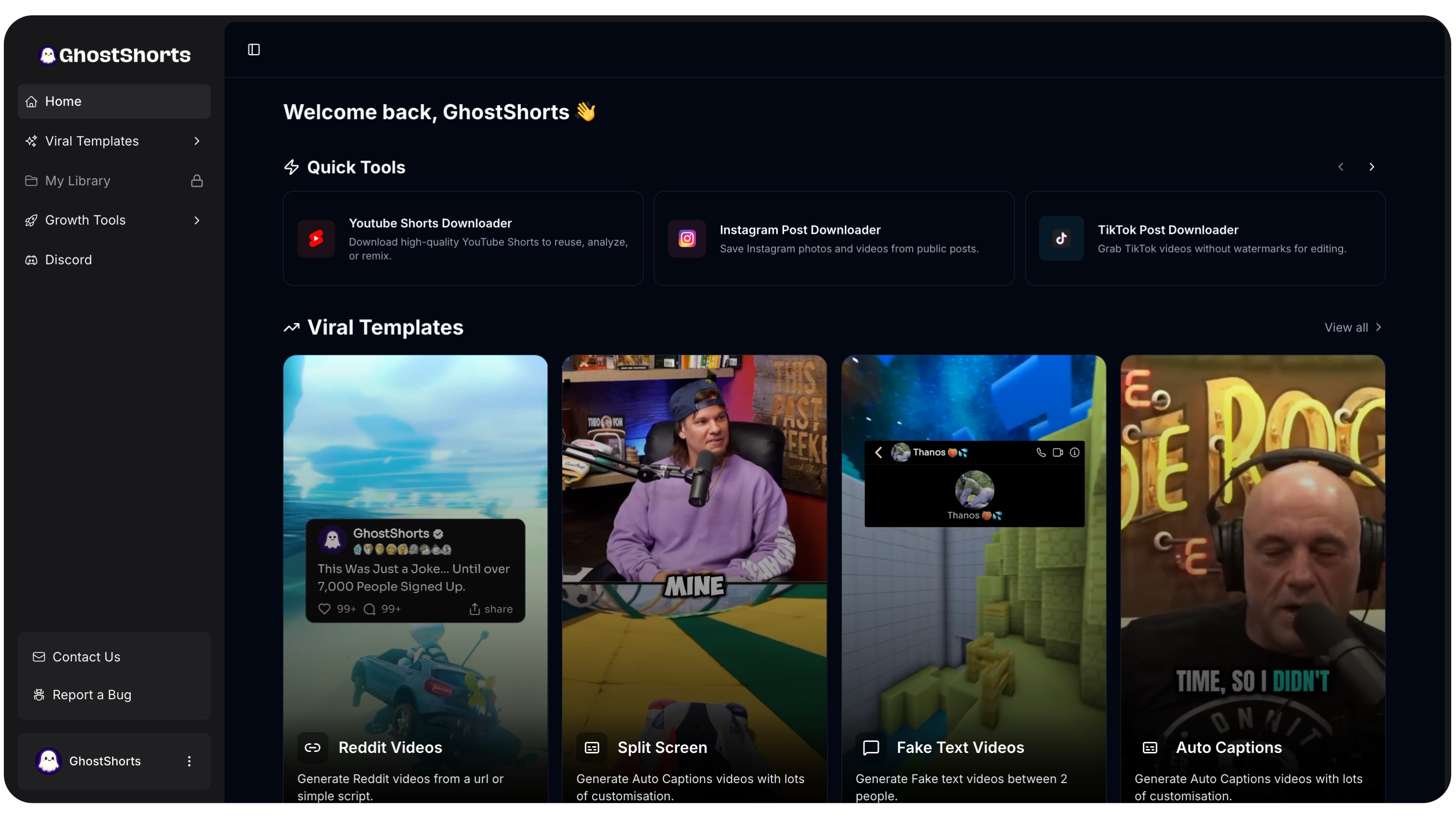
With Ghost Shorts, you can generate faceless videos in minutes. Pick a format, like Reddit stories, split-screen content, or rage bait videos. Add your script, choose a voice, and the platform handles the rest.
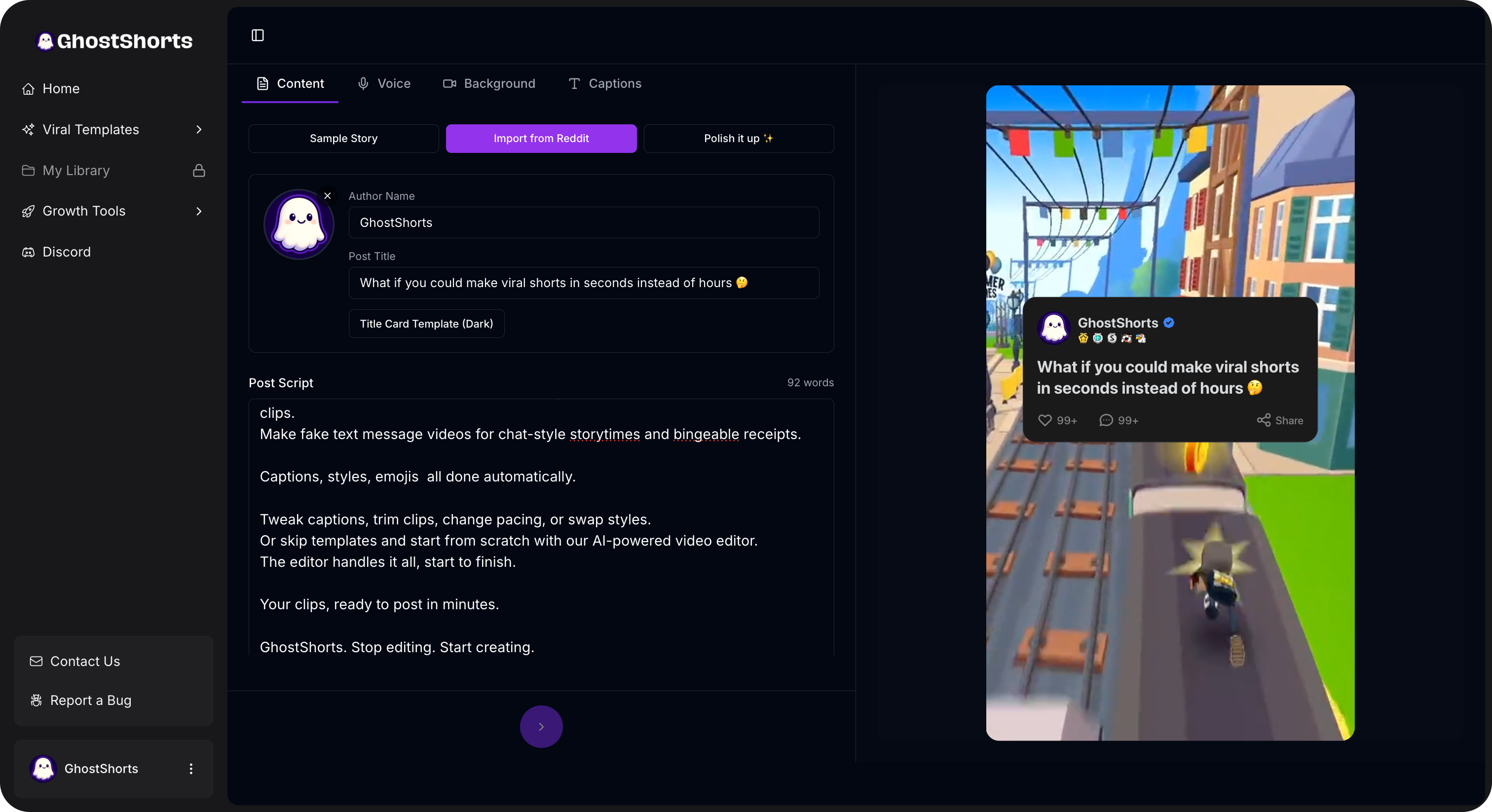
The Reddit story format is especially powerful for faceless creators. These videos consistently go viral because the story format is addictive. People can't stop watching.
Shorts vs Long-Form: Which Should Faceless Creators Focus On?
Both. Seriously.
Here's why.
YouTube Shorts drive subscribers. They're discovery machines. A single viral Short can add 5,000-20,000 subscribers overnight. But the RPM on Shorts is terrible. Like $0.05-0.15 per 1,000 views terrible.
Long-form videos drive revenue. A 10-minute video with mid-roll ads generates 10-50x more revenue per view than a Short. But long-form is harder to go viral with.
So the strategy is simple:
Use Shorts to build your audience. Use long-form to monetize them.
Post 5-7 Shorts per week. Post 2-3 long-form videos per week. The Shorts funnel viewers to your channel. The long-form content keeps them there and generates real money.
Most successful faceless channels in 2026 are doing exactly this. They're not choosing one or the other. They're doing both.
The Realistic Timeline (No BS)
Let's be honest about how long this takes. Because too many gurus sell the "quit your job in 30 days" fantasy.
Here's what actually happens:
Month 1-3: Build Your Library
You're posting consistently. 3-5 videos per week minimum. You're learning what works and what doesn't. Your views are low. Your subscriber count is growing slowly.
Expected results: 100-1,000 subscribers. Some videos get a few hundred views. Maybe one or two pop off.
This is the phase where most people quit. Don't be most people.
Month 3-6: Monetization
If you've been consistent, you should be approaching or hitting the YouTube Partner Program requirements (1,000 subs + 4,000 watch hours).
Expected results: 1,000-10,000 subscribers. You're making your first ad revenue. Maybe $100-500/month. You're starting to understand what your audience wants.
This is when things start getting interesting.
Month 6-12: Scaling
Now you have data. You know which topics perform. You know which thumbnails get clicks. You know your audience.
Expected results: 10,000-100,000+ subscribers. Revenue of $1,000-5,000+/month. Affiliate deals and sponsorships start coming in.
This is where faceless channels really take off because you can scale production. You can't clone yourself on camera. But you can produce more faceless content by systematizing your workflow or using tools like Ghost Shorts to speed things up.
Month 12+: Real Business Territory
At this point, you're running a media business. Multiple revenue streams. Potentially multiple channels. Outsourcing parts of the workflow.
Some creators at this stage are making $10,000-50,000+/month. And they've never shown their face once.
7 Mistakes That Kill Faceless Channels
I've seen hundreds of faceless channels fail. Almost always for the same reasons.
1. Choosing a boring niche.
"Daily weather updates for Topeka, Kansas" is not going to work. Pick niches with proven demand and emotional pull.
2. Inconsistent posting.
The algorithm rewards consistency. Posting 10 videos one week and then disappearing for a month is worse than posting 3 videos every single week without fail.
3. Ignoring SEO completely.
Your title, description, and tags matter. A lot. Faceless channels depend on search and suggested traffic more than face-to-camera channels. If you're not optimizing for keywords, you're leaving views on the table.
4. Terrible thumbnails.
"But I'm a faceless channel, thumbnails don't matter."
Wrong. Thumbnails might matter even MORE for faceless channels because you can't rely on face recognition to grab attention. Use bold text, high contrast colors, and curiosity-driven images.
5. Robotic AI voiceover.
Bad AI voice = instant click away. Invest in a quality AI voice that sounds natural. Adjust pacing, tone, and emphasis. Don't settle for the default robotic output.
6. No call to action.
You'd be shocked how many faceless creators never ask viewers to subscribe, like, or check the description. People need to be told. Ask them.
7. Giving up at month 2.
This one hurts because it's so common. The channel is growing. Slowly. But growing. And the creator quits because they expected overnight success.
YouTube is a marathon. Faceless channels compound over time. Your 200th video will outperform your 20th by a factor of 10x or more. But you have to get there first.
The Bottom Line
You don't need a ring light. You don't need a camera. You don't need to overcome your fear of being on screen.
You need a niche. A workflow. And consistency.
Faceless YouTube channels are one of the most accessible online businesses you can start in 2026. The tools are better than ever. AI voiceover sounds human. Stock footage libraries are massive. And platforms like Ghost Shorts let you produce content at a speed that would've been impossible two years ago.
The only question is whether you'll actually start.
Pick a niche today. Make your first video this week. Post it and don't look at the analytics for 30 days.
Then make another one. And another one.
A year from now, you'll either have a faceless channel making real money, or you'll still be reading articles about how other people do it.
Your call.