

True crime is taking over short-form video in 2026. And it's not even close.
Creators posting 60-second case breakdowns are pulling millions of views on TikTok and YouTube Shorts. Unsolved mysteries, cold cases, forensic deep dives, heist stories. The audience for this stuff is massive and growing.
The best part? You don't need to show your face. Most of the biggest true crime short-form creators use narration, stock footage, and text overlays. No camera required.
Here's exactly how to make true crime videos that rack up views, step by step.
Step 1: Pick Your True Crime Sub-Niche
Not all true crime content is created equal. Some sub-niches perform way better on short-form than others.
Here's what works best in 2026:
| Sub-Niche | Why It Works | Audience Size |
|---|---|---|
| Unsolved mysteries | Endless curiosity, comment engagement | Massive |
| Cold cases | Built-in suspense, serializable | Large |
| Heists and robberies | Action-packed, easy to visualize | Large |
| Disappearances | Emotional hooks, shareable | Very large |
| Forensic science | Educational angle, unique | Growing fast |
| Wrongful convictions | Outrage-driven, high shares | Medium |
Pick one sub-niche and stick with it. The algorithm rewards consistency. A channel that posts only unsolved mysteries will grow faster than one jumping between heists and forensic science every other video.
Think about what genuinely interests you. You'll be researching these cases for hours. If you're not into it, it'll show.
Step 2: Find True Crime Stories Worth Telling
This is where most creators get stuck. Where do you actually find cases?
Public court records. Every state has a public records database. PACER (federal courts) is a goldmine. You can search by case type, date, and location.
News archives. Google News has decades of archived crime reporting. Search for "unsolved case" or "cold case reopened" and filter by date. Local news sites are especially useful because they cover cases that never went national.
Reddit. Subreddits like r/UnresolvedMysteries, r/TrueCrime, and r/UnsolvedMurders have thousands of well-researched posts with sources already cited. These are perfect starting points.
True crime podcasts. Listen to shows like Casefile, Crime Junkie, or Unsolved Mysteries for case ideas. Then do your own research to build an original script.
Wikipedia's list of unsolved cases. Seriously. It's one of the best free resources out there. Each entry links to primary sources you can verify.
Pro tip: Keep a running document of cases you find interesting. You'll burn through ideas fast if you're posting daily.
Step 3: Script Your Video for Maximum Suspense
True crime scripts need to do one thing above all else: keep the viewer watching until the last second.
Here's a simple framework that works:
1. Open with the hook (0-3 seconds). Start with the most shocking or mysterious detail. Not the beginning of the story. The wildest part.
Examples:
- "In 1996, a woman vanished from her locked apartment. The door was bolted from the inside."
- "This man robbed 26 banks and the FBI couldn't catch him for 12 years."
- "Three hikers went into these woods. Only one came back."
If you want to master hooks, check out our guide on how to write hooks for short-form videos.
2. Build tension in the middle (3-40 seconds). Drop details one at a time. Each sentence should raise a new question. Think of it like breadcrumbs.
Don't dump all the information at once. Pace it out. Let the viewer's brain fill in gaps.
3. End with a cliffhanger or reveal (40-60 seconds). Either drop the twist ("The killer was her neighbor the entire time") or leave it open ("This case has never been solved. What do you think happened?").
Open endings drive massive comment engagement. People can't resist sharing their theories.
Keep sentences short. In narrated videos, long sentences lose people. Aim for 8-12 words per sentence max.
Step 4: Record Your Narration (Or Let AI Do It)
You've got two paths here.
Path A: Record your own voice. You'll need a decent USB microphone ($30-60 range works fine) and a quiet room. Speak slowly, clearly, and with slight dramatic pauses. True crime narration should feel like you're telling a story around a campfire, not reading a textbook.
Path B: Use AI voiceover. This is where most faceless creators go in 2026. AI voices have gotten incredibly good. They sound natural, handle pacing well, and you can generate narration in minutes instead of recording take after take.
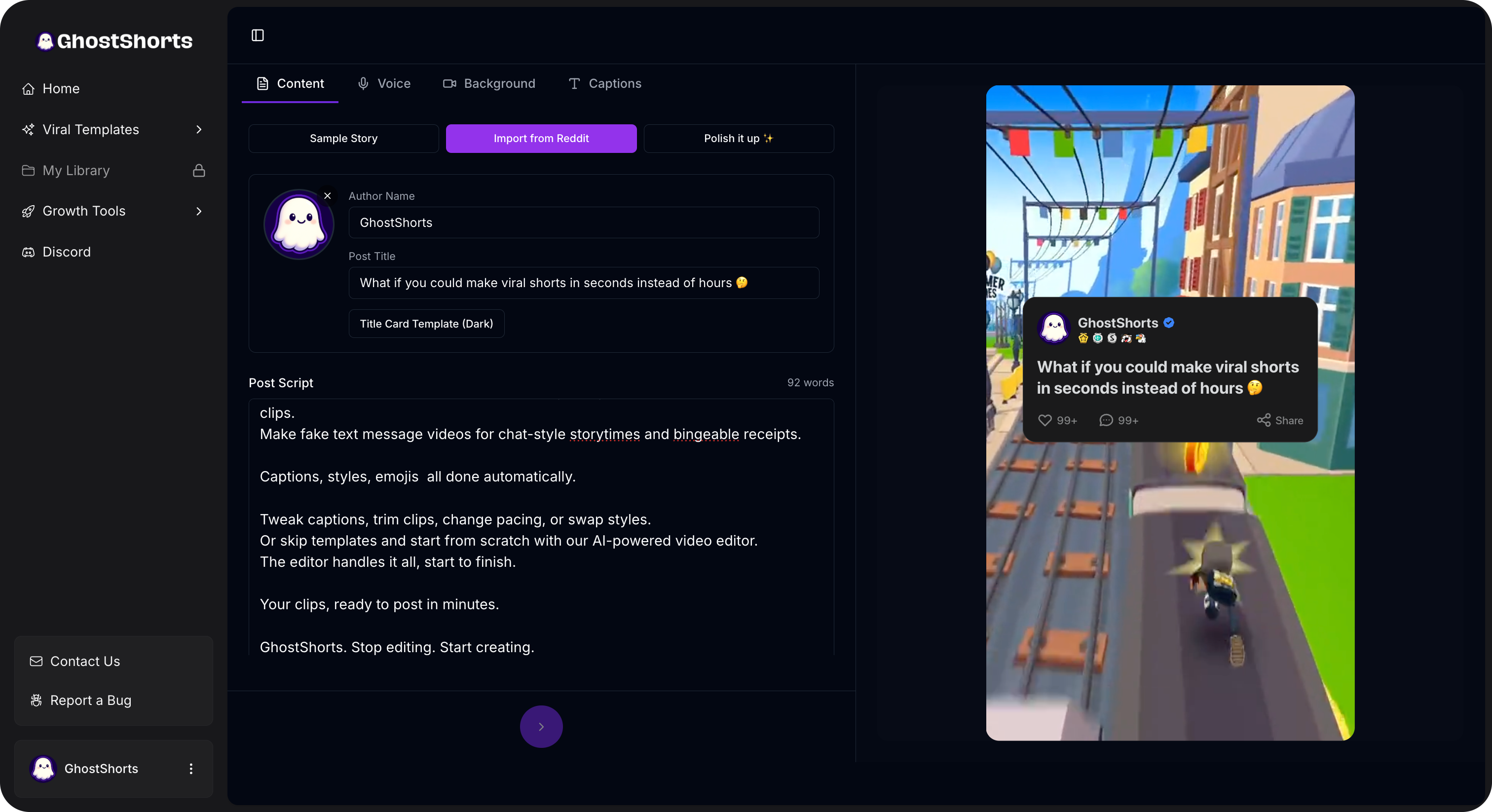
GhostShorts has built-in AI voiceover that works perfectly for this. You paste your script, pick a voice, and it generates the narration automatically. The Reddit Story format is especially good for true crime because it's designed for narrated storytelling with captions baked in.
You can also use the split-screen format to show evidence photos, maps, or court documents on one side while the narration plays on the other. This is huge for true crime because visual evidence makes your content feel more credible and engaging.
Either way, make sure you have auto captions on every video. 80%+ of TikTok viewers watch without sound. Captions aren't optional anymore.
Want to skip the editing?
GhostShorts turns your ideas into viral shorts with AI voiceovers, captions, and gameplay clips. Ready to post in minutes.
Try GhostShorts TodayStep 5: Assemble Your Visuals
True crime videos need visuals that match the dark, suspenseful tone. Here's what works:
Stock footage. Sites like Pexels, Pixabay, and Videvo have free clips of crime scenes, police cars, dark hallways, courtrooms, and cityscapes. Layer these over your narration.
Maps and location shots. Google Earth screenshots showing where events happened add a documentary feel. Viewers love seeing the actual location.
News clippings and headlines. Screenshot old newspaper articles or news broadcasts related to the case. Blur or crop as needed.
Text overlays. Use bold text to highlight key dates, names, and facts. This helps viewers follow along even without sound.
Slow zooms and pans. Don't just slap a static image on screen. Add subtle Ken Burns-style zoom effects to keep things moving visually.
What NOT to use: Never include graphic crime scene photos, autopsy images, or anything that exploits victims. Platforms will flag this content immediately, and it's disrespectful. More on ethics in a minute.
Step 6: Edit for the Algorithm
Your edit style matters more than you think.
Fast cuts. Change the visual every 2-4 seconds. This matches the pacing viewers expect on TikTok and Shorts. Static visuals for more than 5 seconds will tank your retention.
Sound design. Add subtle background music. Dark ambient, suspenseful piano, or lo-fi horror tracks work great. Keep it low enough that narration stays clear. Sound effects at key moments (a door creaking, a phone ringing) add immersion.
Caption styling. Bold, high-contrast captions that animate word by word. This is standard for short-form in 2026. GhostShorts generates these automatically with the AI Caption tool, so you don't have to manually sync anything.
Aspect ratio. 9:16 vertical. Always. No exceptions for short-form.

Step 7: Post Strategically
Making a great video is half the battle. Posting it right is the other half.
Posting frequency. True crime channels that grow fastest post at least once daily. The algorithm rewards consistency above almost everything else. If you can batch-create content using a tool like GhostShorts, you can build a week's worth of videos in one sitting.
Best times to post. For true crime specifically, evenings perform best. 7-10 PM in your target audience's timezone. That's when people are winding down and binge-scrolling. Check our best time to post tool for your specific niche.
Hashtags. Use a mix of broad and niche tags:
- Broad: #truecrime #mystery #unsolved #coldcase
- Niche: #truecrimecommunity #unsolvedmysteries #crimejunkie #truecrimedaily
- Format: #shorts #fyp #storytime
Our free hashtag generator can help you find the right mix.
Series format. This is the cheat code for true crime. Break longer cases into 2-3 part series. End each part with a cliffhanger. Viewers will follow your account just to see the next part. This absolutely destroys on TikTok.
Best True Crime Video Formats for Short-Form
Not sure which format to try? Here's what's working right now:
| Format | Description | Best For |
|---|---|---|
| 60-second case summary | One case, one video, start to finish | Standalone views |
| "What happened to..." series | Multi-part deep dive | Follower growth |
| "This case was never solved" | Open-ended mystery with theory prompt | Comment engagement |
| Evidence breakdown | Focus on one piece of forensic evidence | Educational niche |
| "Red flags everyone missed" | Hindsight analysis of warning signs | Shares and saves |
| Cold case update | New developments in old cases | Timely, trending |
The storytelling-driven formats consistently outperform everything else. If you want to level up your narrative skills, read our guide on how to make storytelling videos that keep viewers hooked.
Monetization: How True Crime Creators Make Money
True crime is one of the highest-RPM niches on both platforms. Here's why.
TikTok Creativity Program. True crime videos tend to be longer (45-60 seconds), which qualifies for higher payouts. Creators in this niche report $0.80-$1.50 RPM, well above average.
YouTube Shorts ad revenue. YouTube pays based on the ads shown between Shorts. True crime audiences tend to watch more Shorts in a session, which means more ad impressions tied to your content. Expect $0.03-$0.08 per 1,000 views to start, scaling with watch time.
Sponsorships. True crime audiences are highly engaged and loyal. Brands in adjacent spaces (VPNs, audiobook services, security cameras, DNA testing kits) pay well for placements. Even small creators with 50K-100K followers can land $500-$2,000 per sponsored video.
Merchandise. True crime communities love merch. "Justice for [victim]" campaigns, podcast-style branding, and niche community gear all sell.
Affiliate links. Recommend the tools and equipment you use. Microphones, editing software, true crime books. Pin affiliate links in your bio.
A Quick Note on Ethics
This matters. A lot.
True crime content involves real victims and real families. Every case you cover represents someone's worst day. Keep that in mind.
Rules to follow:
- Never sensationalize violence. Report facts. Don't dramatize suffering for views.
- Respect victims and families. Use victims' names with dignity. Don't reduce them to clickbait.
- Cite your sources. Mention where you got your information. It builds credibility and shows respect for the people who did the original reporting.
- Avoid graphic imagery. No crime scene photos, no autopsy details, no exploitation.
- Be careful with unsolved cases. Don't accuse specific people unless they've been publicly named as suspects by law enforcement.
- Check your comments. Moderate discussions that get out of hand or target specific individuals.
The creators who last in this niche are the ones who treat it with respect, not just content. Your audience will notice the difference.
Start Making True Crime Videos Today
Here's the honest truth: the true crime niche on short-form is still growing fast. There's room for new creators, especially ones who bring quality research, strong narration, and a respectful approach.
You don't need expensive equipment. You don't need to show your face. You don't even need to record your own voice.
You need a good story, a solid script, and a way to turn it into a video.
GhostShorts makes the production part effortless. Paste your script into the Reddit Story tool, pick an AI voice, and it handles the narration, captions, and visuals automatically. Use split-screen mode to layer in evidence alongside your narration. Add auto captions so every viewer can follow along.
Your first true crime video could be live tonight.
Related reads: